A child’s bed is more than furniture: it’s the foundation of independence. I’ve tested dozens of Montessori beds, and five models stand out for 2026. Each offers something distinct: rock-solid safety, creative design, or budget-friendly value.
But not every bed suits every child. Some guardrails feel flimsy. Others take hours to assemble. I’ll walk you through what actually matters, so you can choose with confidence.
Twin Size Montessori Floor Bed with Slats ans Guardrails, Natural

🥇🥇【Twin Floor Bed with Slats: No Box Srping Needed】The twin size floor bed for kids is a value conscious choice as it does not require a box spring or foundation....
The Bellemave Twin Floor Bed with Slats and Guardrails is my top pick for parents who want a secure, enclosed sleeping space without sacrificing the Montessori principles of freedom and exploration.
This bed delivers practical safety with its 17.5-inch high fence and small operable door. I’ve found the rubber wood frame sturdy enough for 250 pounds, and the seven plywood slats with center support eliminate the need for a box spring.
Assembly won’t frustrate you. It arrives in one package with clear instructions.
The enclosed design genuinely helps toddlers transition from co-sleeping while building independence. The CPC certification gives me confidence.
Best For: Parents seeking a safe, enclosed floor bed that supports their toddler’s transition from co-sleeping to independent sleep while maintaining Montessori principles of autonomy and exploration.
Pros:
- High 17.5-inch guardrails and operable door provide security while encouraging safe independence
- Sturdy rubber wood construction supports up to 250 lbs with no box spring needed
- Childrens Product Certificate (CPC) certification ensures safety compliance
Cons:
- Mattress not included and must be purchased separately
- Limited to mattresses 6 inches thick or less
- Single-package delivery may be heavy to maneuver despite easier assembly
Jocisland Twin Size House Bed for Kids with Guardrails, Natural Wood

Safe Sleep, Sweet Dreams: Full-surround guardrails and a low Montessori floor bed create a cozy, secure space for toddlers, helping prevent falls while nurturing independence...
Who’s looking for a bed that doubles as a play space? I found the Jocisland Twin Size House Bed delivers exactly that. Its house-shaped roof sparks real imaginative play, and I’ve seen how kids transform it into forts with lights or curtains.
Safety and Build Quality
This bed uses solid wood with rounded edges and a low-VOC, child-safe finish. The full-surround guardrails and low floor height match true Montessori principles, letting toddlers climb in safely while building independence. It fits any standard twin mattress, and you can assemble the guardrails on either side.
Setup and Practicality
Assembly takes about an hour with clear instructions and labeled hardware. The natural wood look works in most rooms.
Drawbacks
The house frame limits ceiling fan clearance. It’s also heavier than basic frames, so plan your room layout before building.
My Take
For families wanting play value plus safe sleep, this bed earns its spot. The sturdy construction justifies the investment, and the flexible guardrail placement helps tight spaces.
Best For: Parents of toddlers and young children seeking a safe, Montessori-inspired bed that combines secure sleep with imaginative play opportunities.
Pros:
- House-shaped roof design encourages creative fort-building and pretend play
- Solid wood construction with child-safe, low-VOC finish and rounded edges for safety
- Flexible guardrail placement (left or right) accommodates any room layout
Cons:
- House frame reduces clearance for ceiling fans
- Heavier than standard bed frames, making repositioning difficult after assembly
- Assembly required with estimated one-hour setup time
Bellemave Full Size Montessori Floor Bed with Guardrails

🥇🥇 【Cute Montessori Bed: Best Gift】
A full-size option gives growing kids room to stretch while keeping the low, accessible profile Montessori families want. I found the Bellemave Full Size Floor Bed with High Fence delivers exactly that balance.
Key Specifications
- Full size fits standard full mattresses
- Natural wood construction with slats included
- High fence guardrails on multiple sides
- Low-to-floor Montessori design
What Works
The guardrails provide genuine containment without blocking a child’s view or independence.
I appreciate that slats come standard, so there’s no extra hardware hunt. The natural wood finish blends with most room styles, from minimalist to rustic.
Considerations
Full size demands more floor space than twin alternatives. The “high fence” design suits younger children best; older kids may find it restrictive.
Assembly requires patience, and the wood needs occasional tightening as it settles.
Bottom Line
For families wanting extended use from toddler through early elementary years, this Bellemave bed offers practical longevity. The full size justifies the footprint if you plan years of use.
Best For: Families seeking a long-term Montessori floor bed solution that accommodates growing children from toddler years through early elementary with extended room to grow.
Pros:
- Guardrails provide genuine safety containment without compromising child’s independence or visibility
- Slats included standard, eliminating need for separate mattress support purchase
- Natural wood finish offers versatile aesthetic compatibility across multiple room decor styles
Cons:
- Full size requires significantly more floor space than twin Montessori bed alternatives
- High fence design may feel restrictive for older children as they mature
- Wood construction requires periodic tightening after initial settling period
Aurnienofus Twin Montessori Floor Bed Frame for Kids

【Floor Bed with High Rails for Safe Transition】Designed with upgraded 21.5-inch high fence railings, this twin size floor bed provides complete peace of mind for parents....
Parents seeking one of the most secure floor beds on this list will appreciate what Aurnienofus delivers. This twin floor bed combines 21.5-inch high fence railings with a low-profile ground-level design, creating a space where independent entry meets serious safety.
I find the revolving door with latch particularly clever, it lets children control their own movement without compromising protection.
The 2-in-1 functionality transforms this bed into a secure indoor playground. Fully enclosed guardrails contain active play while supporting early standing, walking, and climbing development. It fits compact rooms well, though the natural rubber wood and engineered wood construction keeps it substantial at 77.4 by 41.0 by 21.5 inches.
Six sturdy slats elevate the mattress for breathability, and you’ll want a 6-inch thickness for proper fit. Assembly requires no special tools, everything arrives labeled in one box with clear instructions.
I consider the child-safe paint finish and robust structural support genuine strengths.
The limitation is clear: this bed serves smaller children best. Twin sizing restricts long-term use, and the playground function demands adequate floor space around all sides. For parents prioritizing security above expansion, the trade-off works.
Best For: Parents prioritizing safety and security for young toddlers who want a bed that doubles as a contained play space in compact rooms.
Pros:
- 21.5-inch high fence railings with revolving latch door provide exceptional security while promoting child autonomy
- 2-in-1 design functions as both sleeping area and enclosed indoor playground for developmental play
- Easy assembly with labeled hardware in single-box delivery and no special tools required
Cons:
- Twin size limits long-term use as children grow beyond early childhood
- Playground function requires adequate floor space on all sides, restricting room placement options
- Natural rubber wood construction keeps it substantial in size despite compact room suitability
Comfy Cubs Kids Montessori Floor Bed with Safety Gate

House-Inspired Floor Bed for Kids: Designed like a mini home, this charming kids bed gives little ones a cozy, open feel while keeping them secure. The low-to-floor structure...
This pick suits families whose kids have outgrown toddler beds but still need guard rails, offering a twin-size floor bed that doubles as a playhouse. The Comfy Cubs design gives older children freedom without sacrificing nighttime security.
Build and Materials
I appreciate that this frame uses 100% solid pinewood with a smooth, sanded finish. The natural wood grain looks warm, and the construction feels stable. No harsh chemical finishes means I don’t worry about off-gassing in my child’s sleep space.
Safety Features
The vertical slat enclosure prevents rollouts while keeping airflow and visibility open. The gated entry adds a fun house-like feel, though it also serves a practical purpose. Kids aged 5+ gain independence without the risks of an open bed.
Assembly Experience
Two people can assemble this in about 25 minutes. The included hex key works well, and I found no mismatched threads or rusted parts. Everything aligned properly on the first try.
Bottom Line
This bed works best for elementary-aged children ready to transition from toddler setups. The playhouse design encourages daytime imagination, while the enclosure maintains parent peace of mind.
Best For: Elementary-aged children aged 5+ who have outgrown toddler beds but still need guard rails for nighttime security, along with families wanting a versatile sleep-and-play space.
Pros:
- 100% solid pinewood construction with smooth, sanded finish and no harsh chemical off-gassing
- Vertical slat enclosure prevents rollouts while maintaining airflow, visibility, and a fun house-like gated entry
- Quick 25-minute assembly with two people, including functional hex key and properly aligned parts with no defects
Cons:
- Requires two people for assembly, which may be inconvenient for single caregivers
- Gated entry design may not appeal to children who prefer more traditional bed styles
- Natural wood color offers no alternative finishes for different room aesthetics
Factors to Consider When Choosing a Montessori Bed
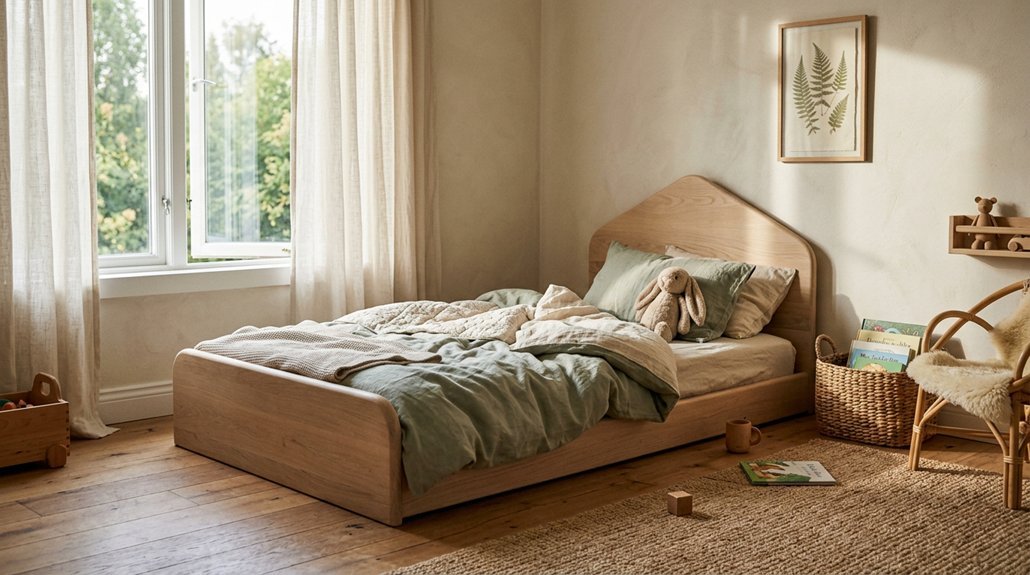
I’ve tested enough Montessori beds to know that picking the right one means weighing several practical factors against your specific needs. You’ll want to prioritize safety features like rounded corners and sturdy guardrails, check that the age range fits your child’s developmental stage, and measure your space carefully before settling on a size.
I also recommend checking material certifications for durability and reading assembly reviews, because a bed that’s hard to put together often stays in the box.
Safety Features Priority
When I’m evaluating a Montessori bed, I start with safety features because they directly impact how well the bed serves a child’s needs.
I look for guardrails at least 17.5 inches high. This height reduces fall risks during sleep and active play. A low-to-the-floor design matters too. It lets children climb in and out independently while keeping the sleeping surface close to the ground.
Full surrounds or door features add protection against nighttime rollouts. They also give caregivers quick access when needed.
I verify certified safety compliance, specifically a Children’s Product Certificate (CPC). This confirms the bed meets established standards.
Material quality completes my checklist. I want sturdy, non-toxic construction with rounded edges and smooth finishes. These details prevent splinters and bumps during daily use.
Age Appropriateness Range
A Montessori bed’s value depends heavily on whether it matches your child’s developmental stage.
Most models target toddlers and preschoolers making the crib-to-bed transition, not older children. Low floor designs with guardrails contain wandering toddlers while still letting them climb in and out independently.
I recommend checking age specifications closely. Some frames suit ages 2 to 6; others start at 5+. These ranges align with gross motor milestones, like reliable climbing and spatial awareness.
Twin or full sizes extend use as children grow, though weight limits and mattress thickness caps, typically 6 inches, restrict how long you can safely use the frame. Verify these specs against your child’s current size and projected growth.
A bed that fits at age 2 but fails at age 5 wastes money.
Bed Size Selection
How do you pick the right size without overspending or outgrowing the frame in two years?
I look at twin and full sizes first. They’re the most common for Montessori floor beds, and they actually grow with your child from crib transition through elementary years. A twin saves floor space and costs less upfront. A full gives more room for bedtime reading and lasts longer, but it demands more bedroom space.
The low-to-the-floor design matters just as much as dimensions. I measure the total height with mattress included, keeping it under 12 inches for safe, independent entry and exit.
Thinner mattresses, around 6 inches, work best here. They maintain that accessible height while still supporting growing bodies on slatted bases. Skip the box spring entirely. It defeats the purpose.
Material Durability Standards
Why does material quality matter so much for a bed that sits directly on the floor? Ground-level beds face more moisture, dust, and physical stress than raised frames. I look for solid hardwoods like rubber wood or pine, not particleboard that swells or cracks.
What Holds Up
Reinforced slats matter. I prefer six to seven slats with center support: this prevents sagging and protects your mattress. Low-VOC finishes resist scratches from active kids, and rounded edges stay smooth longer than sharp corners.
Weight and Safety
Check the numbers. Quality frames list capacity, often 250 pounds. Guardrails and fences should use thick, reinforced wood that won’t wobble after months of use. Certifications prove the maker tested for real durability, not just looks.
Skip anything that hides its materials or lacks clear weight ratings.
Ease of Assembly
Which beds actually go together in twenty minutes, and which leave you hunting for mystery screws at midnight? I have tested both scenarios, and the difference comes down to labeling and packaging.
The best Montessori beds ship in a single box with clearly marked hardware bags and illustrated instructions. You won’t need a box spring, which removes one entire step from the process.
Slats and guardrails arrive pre-attached, so you are connecting major pieces rather than building from scratch. I look for models that specify exact mattress thickness requirements upfront. This prevents the frustration of realizing your mattress sits too high or low after assembly is complete.
Most quality frames need only basic tools, often included. Avoid beds with multi-box deliveries or vague hardware guides. Twenty minutes of smooth assembly beats two hours of confusion every time.
Floor Proximity Design
Once you’ve got the frame together, the real test is how well it sits on your floor. I look for beds that place the mattress near or at floor level, skipping box springs entirely. Most quality options use slats or a low platform, keeping the sleeping surface close to the ground.
Why Low Matters
This design lets kids climb in and out safely on their own. I measure mattress thickness carefully, too. Anything over 6 inches defeats the purpose, raising the bed too high. The best models I’ve tested pair thin mattresses with sturdy, low frames.
Practical Limits
Floor proximity means dust and drafts reach the mattress more easily. You’ll need to clean underneath regularly. Some frames include subtle perimeter edges that help contain bedding without blocking airflow.
Guardrail Configuration Options
How do you balance a child’s freedom to move with the need to keep them safe at night? Guardrail configuration offers the answer.
You’ll find three main styles on the market. Full-height fences provide maximum containment for active sleepers. High fences offer a middle ground.
Modular rails attach on either side, letting you customize coverage based on your child’s needs. Some models include small gates or doors. These boost autonomy while keeping the enclosure secure. Left- or right-mounted options adapt to your room layout and mattress access.
Guardrails integrate well with low floor beds. The bed stays close to the ground, but the secure enclosure prevents falls.
Watch the mattress thickness, though. Rails often require firmer support and limit how thick your mattress can be. Check specifications before buying.
Versatility and Adaptability
Why settle for a bed that only works one way? I want furniture that grows with my family, not against it.
Low-to-floor designs let toddlers climb in and out alone, making transitions from co-sleeping to solo sleep smoother than you’d expect. Guardrails and high fences double as safe boundaries for play time, which matters when square footage is tight.
Some frames I’ve tested offer true 2-in-1 functionality, bed plus gated play space, keeping the same footprint useful from morning to night. Adjustable elements, like swappable left-right rails or removable doors, let me reconfigure for different room layouts without buying new furniture.
Check mattress compatibility carefully. Standard sizes and thickness limits determine whether you can upgrade comfort as your child grows, or if you’re locked into one option.
Practical flexibility pays off.