Like Goldilocks testing every bowl in the cottage, I’ve spent months weighing ingredients on dozens of scales to find the ones that are just right. My kitchen counter became a lab of precision tests, measuring everything from a single gram of yeast to a full Thanksgiving turkey.
Some scales failed within weeks. Others surprised me with accuracy I didn’t expect at their price point. I’ve got ten models worth your attention, plus honest notes on where each one stumbles.
Let’s find the scale that fits your actual cooking habits.
Etekcity Digital Kitchen Scale for Food (304 Stainless Steel)

𝗘𝗳𝗳𝗼𝗿𝘁𝗹𝗲𝘀𝘀 𝗪𝗲𝗶𝗴𝗵𝗶𝗻𝗴: Supports 5 units (oz/lb:oz/fl'oz/g/mL), tare function, and includes 2 AAA batteries for hassle-free...
If you need a scale that handles everyday cooking without fuss, the Etekcity EK6015 deserves your attention.
I tested this stainless steel model on everything from flour to coffee beans. It measures up to 11 pounds with 1-gram precision, and the tare function lets me zero out any bowl instantly. The backlit LCD reads clearly even at odd angles, though the auto-off after two minutes can interrupt longer prep sessions.
Five units switch between grams, ounces, pounds:ounces, and even milliliters for milk or water. The 304 stainless surface wipes clean fast, and at 7.3 by 5.7 inches, it stores easily. Two AAA batteries power it for months.
The 2-gram minimum means it won’t catch tiny amounts well. For jewelry or precise spice measuring, look elsewhere. But for meal prep, baking, and keto tracking? This scale delivers solid performance.
Best For: Home cooks and meal preppers who need a reliable, easy-to-clean scale for everyday ingredients up to 11 pounds, particularly those tracking portions for baking, cooking, or keto diets.
Pros:
- 304 stainless steel surface wipes clean quickly and resists stains
- Five measurement units including grams, ounces, and milliliters for liquids
- Compact 7.3 x 5.7 inch size stores easily in cabinets or drawers
Cons:
- 2-gram minimum measurement misses tiny amounts needed for spices or jewelry
- Auto-off after 2 minutes can interrupt longer food prep sessions
- Requires AAA batteries rather than rechargeable power
Recommended Products
𝗘𝗳𝗳𝗼𝗿𝘁𝗹𝗲𝘀𝘀 𝗪𝗲𝗶𝗴𝗵𝗶𝗻𝗴: Supports 5 units (oz/lb:oz/fl'oz/g/mL), tare function, and includes 2 AAA batteries for hassle-free operation

𝗠𝗮𝘅 𝗖𝗮𝗽𝗮𝗰𝗶𝘁𝘆: Weigh objects as heavy as 22 lb/10 kg and as light as 2 g in increments of 1 g

【PRECISE WEIGHT】 The digital food scale built-in four high-precision load sensors, quickly and accurately response 1g or 0.1oz increments when adding ingredients, its measuring range: 0.1oz to 22 lbs and 3g to 10kg(Min. weigh at 0.1oz or 3g).
Amazon Basics Digital Kitchen Scale (11 lbs)

Digital kitchen scale with food-safe, BPA-free plastic components Stainless steel platform with wide LCD screen Weighs up to 11 pounds (2 grams minimum, up to about 5000...
The Amazon Basics Digital Kitchen Scale suits home cooks who want reliable measurements.
This scale handles up to 11 pounds with 1-gram accuracy, which covers most home cooking needs. I find the tare function essential, it lets me zero out bowls and measure ingredients directly.
The stainless steel platform wipes clean easily. The BPA-free plastic components feel food-safe.
The large LCD display shows pounds, ounces, grams, fluid ounces, and milliliters. Two AAA batteries come included, so you can start weighing immediately. At 8.3 by 7 inches, it fits most countertops without hogging space.
Strain gauge technology delivers consistent readings. The flat design stores well in drawers.
Drawbacks exist. The 11-pound limit excludes heavy bulk cooking. The plastic body lacks premium heft. Readability drops in dim lighting.
For everyday baking, meal prep, and portion control, this scale performs reliably. It is not flashy, but it works. I recommend it for budget-conscious cooks who prioritize function over features.
Best For: Budget-conscious home cooks who need reliable, everyday kitchen measurements without premium features.
Pros:
- Accurate 1-gram precision with versatile units (grams, ounces, pounds, fluid ounces, milliliters) covers most cooking and baking needs
- Tare function enables direct ingredient measurement by zeroing out container weight
- Compact stainless steel design with included AAA batteries allows immediate use and easy storage
Cons:
- 11-pound capacity limits use for heavy bulk cooking or large-scale food preparation
- Plastic construction and dim lighting visibility compromise premium feel and readability
- No backlight or premium materials may frustrate users wanting elevated durability or low-light usability
Recommended Products

[ Large Size, HOLD Function ] The size of weighing platform : 7.2x7.2 inches, more convenient to weigh large-sized items. With the HOLD function, it can be measured even if the size exceeds the weighing pan.

𝗕𝘂𝗶𝗹𝘁 𝗳𝗼𝗿 𝗕𝘂𝗹𝗸 𝗖𝗼𝗼𝗸𝗶𝗻𝗴 & 𝗣𝗿𝗲𝗽: This high-capacity kitchen scale weighs up to 22 lb (10 kg) with 1 g precision, ready for meal prep, holiday baking, sourdough, or grilling. Not for laboratory or microgram measurements.

𝗛𝗶𝗴𝗵-𝗣𝗿𝗲𝗰𝗶𝘀𝗶𝗼𝗻: Minimum Measurements: 1g. Upgraded sensors offer instant readings and reliable measurements for items. Unique Dual Increments: <1000g, 0.1g; 1000-5000g,1g.
Nicewell 22lb Digital Kitchen Food Scale
【PRECISE WEIGHT】 The digital food scale built-in four high-precision load sensors, quickly and accurately response 1g or 0.1oz increments when adding ingredients, its...
Need a scale that handles big batches without losing precision? I’ve tested the Nicewell 22lb Digital Kitchen Food Scale, and it’s built for serious volume.
What Stands Out
This scale measures up to 22 pounds with 1 gram or 0.1 ounce accuracy, four times the capacity of basic models like the 11-lb Amazon Basics. The 9 x 6.3 inch platform fits large bowls easily.
I’ve loaded it with heavy dough mixes, and the four load sensors stay consistent.
Build and Daily Use
The stainless steel surface resists fingerprints. Tempered glass underneath adds strength. Cleanup takes seconds.
The backlit LCD reads clearly in dim light. Tare function works smoothly, zeroing out my mixing bowls instantly. It auto-shuts off to save the included AAA batteries.
Full Readout Options
You get grams, kilograms, pounds, ounces, fluid ounces, and milliliters. That ml/fl. oz conversion helps with liquids.
Minor Limits
At 1.33 pounds, it’s not the most portable option. The minimum 3-gram start weight won’t catch tiny amounts.
The attached hook helps storage, but the plastic base feels less premium than all-metal competitors.
The Bottom Line
For high-capacity home baking, meal prep, or even postage, the Nicewell delivers accurate, flexible performance. The 2-year warranty backs that up.
It’s my pick when I need one scale that handles everything from a chicken breast to a full turkey.
Best For: Home bakers and meal preppers who need high-capacity, precise measurements for large batches and versatile cooking tasks.
Pros:
- 22-pound capacity with 1-gram/0.1-ounce precision handles large ingredients accurately
- Large 9 x 6.3-inch stainless steel platform accommodates big mixing bowls and resists fingerprints
- Six measurement units including grams, pounds, fluid ounces, and milliliters with easy tare function
Cons:
- 1.33-pound weight makes it less portable than compact scales
- 3-gram minimum start weight cannot measure tiny amounts
- Plastic base construction feels less premium than all-metal competitors
Recommended Products
Digital kitchen scale with food-safe, BPA-free plastic components

Contemporary Slim Design: Made of Stainless Steel Material; It is easy to use and clean; Provides accurate weight data with a user-friendly control panel and system; With high precision sensors to ensure correct performance and readouts

[MULTI-FUNCTION SWITCHING MODE]--Food scale can bear a maximum weight of 11LB, and can also provide you with a weight scale accurate to 1 g/0.05 oz. The measurement results are highly accurate. Food scale grams and ounces also has six unit conversion functions: g/kg/lb/oz/ml/milk ml to meet your different needs. When you are making food, there is no need for complicated operations, just one button to easily switch to any unit you want, providing all-round convenience for kitchen work.
33lb Digital Kitchen Food Scale, Rechargeable Stainless Steel (Black)
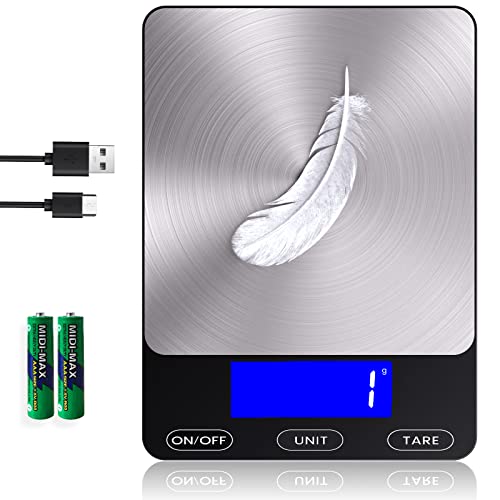
【Precise Weight Food Scale】Our Food Kitchen Scale equips four high-precision load sensors, waterproof Anti-collision glass weighing panel. Large measuring capacity with...
Looking for a scale that handles big jobs without hogging counter space?
I tested the GGQ 33lb Digital Kitchen Scale, and its 7.5 x 5.5 inch stainless steel panel delivers serious capacity in a medium footprint. Four precision sensors measure from 3 grams to 33 pounds with 1-gram accuracy.
I appreciate the rechargeable Type-C power, plus included backup batteries. The waterproof glass surface wipes clean fast, and the tare function works smoothly for bowls and plates.
Five units (g, kg, lb:oz, oz, ml) cover most cooking needs. The auto-off after two minutes saves juice, though I sometimes wish it lasted longer during slow prep. The hanging hook helps storage.
For home cooks needing higher capacity without commercial bulk, this scale proves practical and precise. Twelve-month support adds confidence.
Best For: Home cooks and meal preppers who need high-capacity weighing up to 33 pounds in a compact, rechargeable kitchen scale without commercial bulk.
Pros:
- Rechargeable Type-C power with included backup batteries
- Four precision sensors deliver 1-gram accuracy across an exceptionally wide 3g to 33lb range
- Waterproof glass surface and stainless steel panel combine durability with easy cleaning
Cons:
- Auto-off after two minutes can interrupt slow prep sessions
- Medium 7.5 x 5.5 inch footprint may still crowd very small kitchens
- Five measurement units lack some specialty options like fluid ounces for precise liquid conversion
Recommended Products

Stainless Steel is Smudge and fingerprint-resistant

Lightweight Postal Scale - Max. Capacity: 440lb/200kg, Min. Readability: 40g, Display Resolution: 10g. Features a Carbon Fiber platform paired with a durable ABS housing. Lightweight + sturdy, easy to clean, move, and store.

𝗬𝗼𝘂𝗿 𝗛𝗲𝗮𝗹𝘁𝗵 𝗘𝘅𝗽𝗲𝗿𝘁: Easily track your intake of up to 19 nutrients, monitor trends, create daily, weekly and monthly nutrition reports and more by connecting to the free Vesync app, Apple Health and Fitbit
Escali Primo Digital Kitchen Scale, Chrome
Who’s it best for?
I recommend the Escali Primo for home cooks who want reliability without complexity. It handles everyday weighing tasks with straightforward controls that won’t confuse beginners.
Key Specifications
- Capacity: 11 pounds (5,000 g)
- Accuracy: 1 gram increments
- Units: ounces, pounds:ounces, grams
- Size: 8.5 x 6 x 1.5 inches
- Power: Automatic shut-off after 4 minutes
What Works
The sealed two-button panel shrugs off spills. The tare function resets quickly for measuring multiple ingredients. I appreciate the compact footprint; it stores easily in crowded drawers. The lifetime warranty shows Escali stands behind this plastic-bodied scale.
Limitations
The 1-gram precision suits cooking but falls short for serious coffee brewing or jewelry work. The plastic construction feels less premium than metal alternatives. You’ll need to buy the stainless steel platform cover separately if you want extra protection.
Bottom Line
This scale delivers consistent accuracy and proven durability. For most kitchens, that’s enough.
Best For: Home cooks seeking a reliable, easy-to-use digital scale for everyday kitchen weighing tasks without complicated features.
Pros:
- Sealed two-button control panel resists spills and simplifies operation for beginners
- Compact 8.5 x 6 x 1.5-inch footprint stores easily in crowded drawers
- Lifetime warranty backs up the scale’s proven durability
Cons:
- 1-gram accuracy falls short for precision tasks like serious coffee brewing or jewelry work
- Plastic construction feels less premium compared to metal alternatives
- Stainless steel platform cover must be purchased separately for extra protection
BakFee 33lb Digital Kitchen Scale (USB Rechargeable)
Why juggle multiple scales when one handles everything from a few grams to 33 pounds? The BakFee 33lb Digital Kitchen Scale handles that exact range, measuring from 3 grams up to 15 kilograms with 1-gram precision.
Key Features and Design
I like the 9-by-6.3-inch platform built from stainless steel and tempered glass. It wipes clean easily, and the splash-resistant surface shrugs off spills.
The large display sits where I can still read it, even with a big mixing bowl or sheet pan blocking most of the surface.
Power Options
You get dual power choices here. The built-in rechargeable lithium battery charges via USB, which I find more convenient and less wasteful than tossing batteries.
Still, BakFee includes two AAA batteries if you prefer backup power or forget to charge.
Practical Functions
The tare function zeros out container weight quickly. Six units cover most needs: grams, kilograms, pounds, ounces, fluid ounces, and milliliters.
The scale shuts off after two minutes to save energy, though I sometimes wish that window were longer during slow prep work.
Storage and Dimensions
At 7.3 by 10 by 1.4 inches overall, it stores flat or hangs on the included hook. The Rechargeable-Black finish looks standard, not flashy.
My Assessment
For everyday cooking, baking, and meal prep, this scale performs reliably. The 33-pound capacity beats most competitors in this range.
My main caution: accuracy dips slightly at the very lowest weights, so measure under 5 grams with extra care. For most home cooks tracking portions or scaling recipes, it delivers solid value with flexible powering.
Best For: Home cooks and bakers who need a versatile, high-capacity kitchen scale for everyday meal prep, recipe scaling, and portion tracking with flexible USB rechargeable or battery-powered operation.
Pros:
- Dual power options with USB rechargeable lithium battery and included AAA backup batteries for convenience and flexibility
- Large 9×6.3-inch splash-resistant stainless steel and tempered glass platform accommodates big bowls and sheet pans while remaining easy to clean
- Wide 3 g to 15 kg (33 lb) measuring range with six unit options (g, kg, lb, oz, fl’oz, ml) covers most kitchen tasks
Cons:
- Accuracy decreases slightly at very low weights below 5 grams, requiring extra care for precise small measurements
- Auto-off after 2 minutes may interrupt slow prep work and cannot be adjusted or disabled
- Rechargeable-Black color finish is basic and lacks aesthetic variety for style-conscious kitchens
Recommended Products

【Two Power Source】:USB charging or 2 AAA batteries power supply, you can use it more reliably.
【Precise Weight Food Scale】Our Food Kitchen Scale equips four high-precision load sensors, waterproof Anti-collision glass weighing panel. Large measuring capacity with 1g precise graduation from 0.1oz/3g to 33 lbs/15kg.

【Precise Weight】 10kg/22lb capacity, 1g/0.1oz resolution, Great for cooking, baking, weight loss, Meal Prep, Coffee, Package, Postage.
Digital Kitchen Food Scale with LCD Display
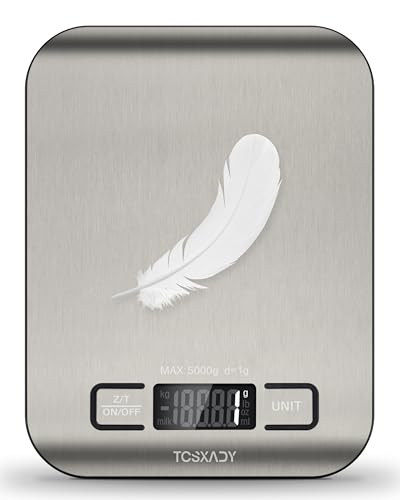
【Versatile Measurement Mastery】Tcsxady food scale supports 6 units (g/kg/lb/oz/ml/milk ml) for baking, meal prep, or liquid tracking. Optimized for recipes requiring...
Need a scale that handles both dry ingredients and liquids without fuss? I found the Tcsxady Food Scale covers both bases with six units, including gram, kilogram, pound, ounce, milliliter, and milk milliliter. That milk ml mode stands out, it calculates liquid volumes without requiring a separate container conversion.
Key Details
The scale measures up to 11 pounds with 1-gram precision.
I appreciate the overload alerts and low-battery warnings, they prevent mid-recipe surprises. The tare function zeros out container weight instantly, and the backlit LCD stays readable even in dim kitchen lighting.
Build and Daily Use
At 304 stainless steel with an ABS surface, this handheld unit resists stains and wipes clean fast.
The auto shut-off after two minutes saves battery life, though I sometimes wish the window were longer during complex prep. It runs on included AAA batteries.
My Take
For bakers tracking macros or cooks watching liquid intake, this scale delivers precise conversions without clutter. The compact size stores easily, but the 11-pound limit won’t suit bulk shoppers.
I recommend it for everyday meal prep and standard home recipes where portability matters.
Best For: Home cooks and bakers who need precise measurements for everyday meal prep, macro tracking, and liquid volume calculations in a compact, portable scale.
Pros:
- Six measurement units including specialized milk ml mode for direct liquid volume readings
- 1-gram precision with tare function and backlit LCD for accurate, easy-to-read measurements
- Stain-resistant stainless steel and ABS construction with auto shut-off for low-maintenance daily use
Cons:
- 11-pound capacity limits use for bulk ingredients or large-scale cooking
- Two-minute auto shut-off may interrupt complex, multi-step prep sessions
- AAA battery power requires eventual replacement rather than rechargeable convenience
Recommended Products

【High Precision & Wide Capacity】: This digital food scale supports up to 33lb weight measurement with 1g/0.05oz graduation, delivering accurate readings for cooking, baking, and daily weight management

Meticulous Accuracy: Equipped with 4 high precision sensors to provide the most accurate weight readings. Refined accuracy 0.01 g / 0.001 oz, up to a weight range of 0.05 g - 500 g/ 17.64 oz

#Precise Measurement# - KitchenTour EG5001 features a weight capacity from 0.3g - 3000g with the precision of 0.1g to help you measure jewelry, medicine, and cooking ingredients with refined accuracy.
Greater Goods Digital Food Scale for Kitchen & Baking
𝗕𝘂𝗶𝗹𝘁 𝗳𝗼𝗿 𝗕𝘂𝗹𝗸 𝗖𝗼𝗼𝗸𝗶𝗻𝗴 & 𝗣𝗿𝗲𝗽: This high-capacity kitchen scale weighs up to 22 lb (10 kg) with 1 g...
Looking for a scale that won’t flinch at a double batch of sourdough? I’ve tested the Greater Goods Digital Food Scale, and its 22-pound capacity handles bulk baking without breaking a sweat.
The stainless steel platform wipes clean fast. The bright LCD stays readable even when I’m weighing into a deep mixing bowl.
Key Features I Noticed
- Measures grams, ounces, lb:oz, and milliliters in 1-gram increments
- ZERO function tares containers instantly
- HOLD keeps readings visible for 5 minutes
- Display extends past the platform for awkward angles
Build and Size
At 7.6 x 5.6 x 1.3 inches, it stores almost anywhere. Three AAA batteries power it; auto shut-off kicks in after 2 minutes to save juice.
Support and Limits
The 5-year warranty and St. Louis-based lifetime support impress me. Just know: this isn’t for lab-grade precision.
For home bakers and meal preppers, it’s a solid, no-fuss choice.
Best For: Home bakers, sourdough enthusiasts, meal preppers, and health-conscious families who need a high-capacity, easy-to-clean scale for everyday kitchen weighing tasks.
Pros:
- 22 lb / 10 kg capacity with 1 g precision handles bulk baking and large ingredients with ease
- Tare, Hold, and extended-display features add practical convenience for real-world kitchen use
- Low-maintenance stainless steel platform and 5-year warranty with lifetime St. Louis-based support
Cons:
- Not suitable for laboratory or microgram-level precision needs
- Auto shut-off after 2 minutes may interrupt longer, slower prep sessions
- Battery-powered only (3 AAA), with no AC adapter option for continuous use
Recommended Products
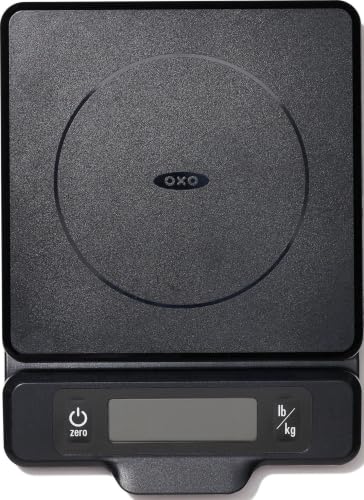
5-pound-capacity Food Scale measures in 1/8-ounce and 1-gram increments
【Versatile Measurement Mastery】Tcsxady food scale supports 6 units (g/kg/lb/oz/ml/milk ml) for baking, meal prep, or liquid tracking. Optimized for recipes requiring precise conversions, it replaces guesswork with quick-tap unit switching. Ideal for food scales for kitchen enthusiasts prioritizing flexibility.

【VERSATILE MEASURING FOR EVERY RECIPE】Switch between 7 units—g, kg, lb, oz, lb:oz, fl oz, and ml—to measure ingredients your way. This food scale works as a reliable kitchen scale for baking, coffee, cooking, meal prep, and portion control, giving you the flexibility to follow recipes with ease.
OXO Good Grips 5-lb Kitchen Scale with Pull-Out Display, Black
5-pound-capacity Food Scale measures in 1/8-ounce and 1-gram increments Display pulls away from base to avoid shadowing from plates or bowls Zero function tares Scale before...
Who’s this scale really for?
I recommend this OXO scale for home bakers who use large mixing bowls and hate squinting at shadowed displays. The pull-out screen solves a real problem: you can read measurements even when your bowl covers the base. The 5-pound capacity handles most kitchen tasks, and the meter shows how much room you’ve got left.
The zero function lets me tare between ingredients without math. I like the removable platform for quick hand washing, and the thin profile slides into drawers easily. The 1/8-ounce and 1-gram precision works for most recipes.
Drawbacks exist. Five pounds limits bulk shoppers. The optional backlight drains batteries faster. Some competitors offer higher capacity at lower prices.
Still, the thoughtful design justifies the cost. The pull-out display isn’t a gimmick, it’s genuinely useful. For everyday cooking and baking, this scale delivers reliable performance without frustration.
Best For: Home bakers who use large mixing bowls and need an easy-to-read display without shadowing issues.
Pros:
- Pull-out display eliminates shadowing from large bowls and plates for clear reading
- Removable platform enables quick hand washing and easy maintenance
- Zero tare function allows seamless measurement of multiple ingredients without manual calculations
Cons:
- 5-pound capacity limits use for bulk shopping and larger quantities
- Optional backlight feature drains batteries faster than normal operation
Recommended Products

Precise measurement: weigh up to 11 lb; Increments: 0.1oz/1g/1mL; minimum weight recommendation: 5 g Multifunctional: quickly convert units between oz, lb: oz, g, mL, and...
My Weigh KD-8000 Digital Food Scale, Stainless Steel, Silver
The My Weigh KD-8000 is built for home bakers who need serious precision without kitchen clutter.
This compact mini scale fits tight counter spaces. Its stainless steel finish resists flour dust and sticky spills better than plastic rivals. The digital readout shows grams and ounces clearly, even when I’m measuring small amounts of yeast or salt.
I appreciate the KD-8000’s steady performance for bread baking. It handles bowls up to its capacity without wobbling. The COMINHKPR107484 model runs on batteries, so I keep spares handy. No power cord means flexible placement.
Drawbacks exist. The mini size limits large mixing bowls. You’ll need to tare frequently with big recipes. There’s no pull-out display like some competitors offer.
Compared to the OXO Good Grips scale I covered earlier, this trades screen flexibility for durable metal construction. The OXO suits casual cooks. The KD-8000 rewards dedicated bakers who value longevity over gadgets.
Verdict: A reliable, no-frills workhorse for precise kitchen work.
Best For: Dedicated home bakers who prioritize precision and durability over extra features in a compact digital scale.
Pros:
- Compact stainless steel construction resists flour and spills better than plastic alternatives
- Clear digital readout displays grams and ounces accurately for small measurements like yeast and salt
- Battery-powered operation enables flexible placement without cord restrictions
Cons:
- Mini size limits use with large mixing bowls
- Requires frequent taring when working with big recipes
- Lacks pull-out display feature found on competitor models
Recommended Products
𝐂𝐨𝐦𝐩𝐚𝐜𝐭 𝐅𝐨𝐨𝐝 𝐒𝐜𝐚𝐥𝐞 𝐟𝐨𝐫 𝐃𝐚𝐢𝐥𝐲 𝐔𝐬𝐞: Slim digital kitchen scale for cooking, baking, meal prep, and portion control. Its sleek 0.5-inch profile stays close at hand without taking up valuable counter space.

Accurate Measurements: This digital kitchen scale offers precise readings in grams and ounces for accurate meal prep and portion control. Perfect for weight loss, baking, and cooking, it ensures flawless measurements every time.

The Pocket Gram Scale Size is 5.2 x 2.99 x 0.79 inch, Gram Scale allows you to weigh a maximum capacity of a 200g and the minimum accuracy is 0.01g, to guarantee you an accurate and precise weighing session. Not suitable for weighing items weighing over 200g, please choose carefully
Factors to Consider When Choosing Kitchen Scales
I’ll pick a scale based on what it’ll actually handle, so I always check weight capacity limits and whether it switches between grams and ounces easily. Accuracy matters most to me. I’ve seen cheap scales miss by five grams, which ruins baking.
I also test the platform size and display visibility in bright kitchens, because cramped or dim screens slow me down.
Weight Capacity Limits
How much weight do you actually need to measure? I always check capacity first. Kitchen scales range from about 5 lb (2.3 kg) on compact models up to 33 lb (15 kg) on larger units. Most scales I test fall at 11 lb (5 kg), which handles daily cooking fine.
Pick a scale that covers your typical needs comfortably. Overloading causes damage and bad readings. I also watch minimums: some scales need 2–3 g before they stabilize. That matters when you’re measuring spices or yeast.
Higher capacity doesn’t mean better precision. A 33 lb scale might read in 1 g increments, while an 11 lb model hits 0.05 oz. Match capacity to your actual habits, not theoretical maximums.
Measurement Unit Options
What units do you need on your scale? Most digital scales I test offer grams and ounces as standard. Many add pounds-and-ounces and milliliters for liquids. I find this covers most home cooking needs.
Some models go further. They include fluid ounces and milk-specific milliliter modes. These let you measure liquids directly without converting mentally.
A few scales show combined oz/ml readouts, which helps with recipe scaling and diet tracking. Unit switching usually works via a dedicated button. Some units auto-tare when you switch, showing net contents immediately. This saves time during prep.
Watch for precision limits. Most scales measure in 1 gram or 0.05 to 0.1 ounce increments. That is fine for baking, but less ideal for tiny spice amounts. Check the specs before you buy.
Accuracy And Precision
Why does accuracy matter so much in a kitchen scale? Baking requires exact ratios. A few grams off ruins bread or pastry. I look for scales with 1 g or 0.1 oz precision as the baseline. Most models advertise this, but real performance varies.
Readout accuracy tells you how close the display gets to true weight. I test this with calibrated weights. Some 22 lb capacity scales maintain 1 g precision even at small amounts, thanks to multiple load sensors. Others drift near their maximum.
Multiple unit options help preserve precision across systems. I switch between grams and ounces depending on the recipe.
The tare function proves essential. I zero out my bowl, then add ingredients. This isolates net weight precisely. Without reliable tare, you’re guessing, not measuring.
Platform Size Matters
Precision means nothing if your bowl doesn’t fit. I’ve tested scales with platforms ranging from compact 7.3 x 5.7 inches to generous 9 x 6.3 inch surfaces, and the difference matters.
Why Size Affects Accuracy
A larger platform stabilizes heavy or irregular items. When bowls overhang, readings drift. I’ve watched 2-pound bags of flour wobble on small platforms, while wide surfaces keep everything steady.
The Trade-Off
Smaller platforms win on portability. They slip into shallow drawers without fuss. But for daily baking, I prioritize surface area.
What to Check
Compare platform dimensions against your typical containers. Pair this with weight capacity. A large surface with low capacity wastes space.
I prefer stainless steel or tempered glass platforms with non-slip feet. The combination handles bulky mixing bowls without sliding, giving reliable measurements every time.
Display Visibility Features
How often have you leaned over a mixing bowl, squinting at tiny digits that seem to disappear in your kitchen’s afternoon shadows? I have, and it is frustrating.
A backlit LCD display solves this problem. It brightens the screen so you can read measurements in dim corners or under harsh overhead lights.
Large font size matters too. Bigger numbers reduce eye strain when you are moving quickly between tasks. High-contrast displays, like white digits on black backgrounds, stay visible even when bowls cast shadows. Some scales use a pull-out or extended display. This design keeps the screen clear of container shadows entirely.
Watch out for aggressive auto-off features. If the screen sleeps mid-recipe, you may need to wake it and re-check your measurement. Small inconvenience, but worth noting.
Tare Function Utility
Where would I be without the tare button? I’d be doing math in the middle of recipes, and nobody wants that.
The tare function lets me zero out my bowl or plate, so I weigh only the food inside. I place my container, hit tare, and the scale resets to zero. Then I add flour, tare again, add sugar, and keep going without dirtying extra dishes.
Most scales I tested handle this smoothly. The best ones respond instantly with no lag between presses. I appreciate models that pair tare with multiple unit options: grams, ounces, pounds and ounces, or milliliters for liquids. This flexibility matters when I’m converting between recipes.
One caution: some scales with aggressive auto-off features interrupt my workflow. I prefer units that stay awake long enough for complex prep.
Power Source Types
Once I’ve sorted out how a scale handles tare functions, I turn my attention to what keeps it running.
Most kitchen scales run on disposable AAA batteries or built-in rechargeable power via USB-C. I’ve found rechargeable models convenient for daily use, though you’ll need to track charge levels. Battery-powered units offer quick swaps when power runs low, but I recommend keeping spares handy and never mixing new with used batteries.
Some scales provide dual power options, giving flexibility I appreciate in busy kitchens. A few include AC adapters for stationary setups.
I always check for auto-off features, which extend battery life significantly. Rechargeable scales typically show low-power indicators, preventing mid-recipe shutdowns. For portability, I favor USB-rechargeable models. For backup reliability, dual-power designs prove most dependable.
Cleaning And Maintenance
Why let a tricky cleanup ruin your workflow? I always check the surface material first. Stainless steel or tempered glass wipes clean fast and resists stains. Skip scales with deep grooves where flour hides.
I look for flat, seamless platforms. Fewer crevices mean less scrubbing.
The tare function matters more than you’d think. I zero out with my own bowl, so I never wash the scale’s tray. That’s one less step.
Auto-off saves batteries. I don’t want to open the compartment monthly. Some scales hold the display after I remove the bowl. I can verify weights even after wiping down.
Maintenance should be simple. A scale that fights you during cleanup wastes time you could spend cooking.